
Friday, 22 May 2015

Organizations That Help Gender Equality (Part 2)

HeForShe is a campaign that aims to achieve gender equality. HeForShe was launched September 20th, 2014 by the United Nations. The day included a conference to talk about getting involved in the fight for gender equality. HeForShe describes themselves as having one half of the world’s population fighting for the other half, to benefit everyone.
The ‘HeForShe’ commitment is a pledge that men can take on the HeForShe homepage
( http://www.heforshe.org/ ) that states that they understand that gender equality is not only a women’s issue, and that we need everyone to take part in this. Currently, more than 300 000 men have taken the pledge across the world.
I am fully in support of the HeForShe campaign. Since its beginning, I have been talking about the conference with people I know, and spreading the campaign. My attention to this movement was first caught when I came across a video that included one of my favorite people, Emma Watson. Emma Watson spoke at the campaign launch as the UN Women’s Goodwill Ambassador, and she spoke her fifteen minute speech without me once disagreeing with her. I am sure that, if you take the time to watch this life-changing video, you will be able to begin to see why, and how, I am so passionate about gender equality.

In the speech, a few key things talked about are:
- Gender equality is not just a women’s issue, and we need the help of as many men and boys as possible.
- Gender equality shouldn’t just be talked about, we should make sure that it will last.
- Feminism and how so many people see it as man-hating. Many people are ‘afraid’ of the word, but it shouldn’t be the word that matters, it should be the idea and the drive behind it to make a change.
- Gender based assumptions.
- There is no country anywhere in the world where all women can expect to have their human rights.
- How can we have change when only half of the population are welcome in the conversation?
- When men are free from male stereotypes, there will be a natural consequence and everybody (men and women) will see change.
- “If not me, who? If not now, when?”
Also within Emma’s speech, she introduced some staggering facts that will be true if we do not make the change, and make gender equality a true, tangible thing.
- If we do nothing, it will take seventy-five (75) years before women will be payed the same as men.
- 15.5 million girls will be married as children in the sixteen (16) years.
- It will be the year 2086 before all rural African girls can have a secondary education.
HeForShe is a relatively new organization that is a push in the right direction. Since its launch, it has reached out to so many people across the world. As of now, Canada has 15 571 men who have signed the pledge. I think that even though this is a relatively small number in perspective, it is also a great number. This number tells people that although we are working hard, we do not have everyone participating, and we still have a long way to go.

Organizations That Help Gender Equality (Part 1)

The International Women’s Rights Action Watch (IWRAW) began in 1985 in Kenya at a conference talking about women’s rights. The IWRAW operates as a non-governmental organization that aims to promote the recognition of women’s rights, including how they are being acknowledged and not acknowledged. They talk about the discrimination of women, for example in some parts of the world, non-equal pay for men and women. They believe that females are needed for development. Without females, there is only half of the population working for a better world, and only half of the population participating in society. The NGO is international, working across the world, and started as multiple NGOs and activists who wanted to see change.
The IWRAW is educating people by having conferences and group discussions about the violations of women’s rights. Basically, they are spreading their side so people can make their own decision to become activists. The IWRAW is, in my opinion, keeping the conversation going so that this issue is not forgotten about. This organization is fighting for equality and women’s rights, therefore they see the issue, which personally shows me that there are still people who believe in what I see as rights that should be available for everyone.
Men's Rights
Too often in today’s society, the focus of gender equality is on women. Speeches, organizations, and campaigns are focused on improving the lives of females. I fully support these actions, however, before going out of my way to search for information on the male perspective, I couldn’t fully realize or understand that men had issues too. I am living in a world where ‘gender equality’ advocates always speak from a women’s perspective and talk about women’s issues.
To put it into perspective, men on ships face a hugely unfair disadvantage in the way that women and children are expected to be put to safety first. If gender equality is a rising issue to be talked about and solved, why haven’t people began to change their idea of this everyday thing? If you are male on a sinking ship, your gender automatically puts expectations onto you and increases your chance of being fatally hurt.
Based on a recent study from Ohio University, eighty percent (80%) of suicide victims are male, ninety-three percent (93%) of workplace fatalities are male, seventy six percent (76%) of homicide victims are male, and sixty one percent (61%) of homeless people are male. This clearly shows that males and females are not equally treated with opportunities. I think that a strong reason for these numbers could be from the stereotypes of females being more ‘fragile’ and ‘helpless’. So much of society still sees the female gender as weak that more focus is put on them to make sure that they do okay in life. I see this privilege and biases toward females in my own school where all four of grade nine student speakers at graduation are female. The male percentage of grade nine students in my school are not even given a chance to speak at their own graduation. This simple thing completely puts girls in a higher academic place than boys, which put into a dramatic sense, is very much so evidence for the results of Ohio University’s study.
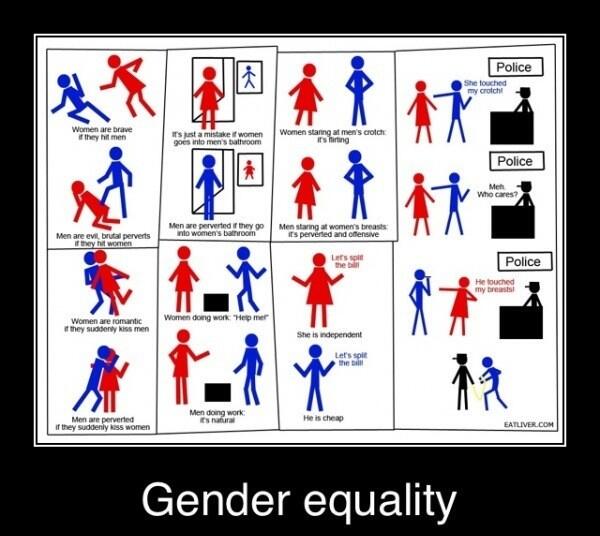
(Link for larger sized image: https://pbs.twimg.com/media/BJSOWvaCQAEp23y.jpg )
This image shows what I believe to be a very true representation of things that happen every day. (Disclaimer: the perspective of this is one that I personally think shows both sides of everyday issues, but I do not necessarily confine my opinion of these issues strictly to this. I know that there are other ways this image could be interpreted, and I am very open to other opinions of what is shown here. There is so much of a grey area with these opinions, and it may never be black and white.)
Women are most often thought of as the gender to be pressured with expectations of body image. Personally, I have heard so many people talking about the pressure of girls to live up to a picture in a magazine, there have been so many discussions about it. For this particular example, Seventeen magazine has a stamp with girl power written on it that is beside many female celebrities and articles about girls. This is seen as a positive thing, that could inspire it’s female audience. On the other hand, this magazine has pages of each issue dedicated to its ‘hot guy panel’. These pages include shirtless photos of males with (photo-shopped) muscles and all the same sort of look. This is a double-standard! Three percent (3%) of women will develop eating disorders from the ‘pressure to be beautiful’ they see in magazines. Four to six percent (4-6%) of men turn to steroids.
On the website tumblr, there is a blog dedicated to why people need men’s rights. (http://ineedmensrights.tumblr.com/ ) A few of the submissions are:
- “I need the men's rights movement because when I was looking for a place to rent, over half the posted ads clearly stated “seeking female tenants only”.”
- “I need the men's rights movement because so many people in this world think that “pro-man” is inherently “anti-woman”.”
- “I need the men's rights movement because on the third day of me participating in Movember, I was warned that I’d look like a sex offender”.”
- “I need the men's rights movement because my father was forced to pay my mother child support for 18 years, despite not once consenting to raising a child. That child was me, and I know that is wrong”.”
These few entries got my attention because I can understand where the blogger is coming from. I have seen and heard all of these things many times in my life, and before reading his posts I never thought anything of them. The fact that all of these things are going on right now, without a second thought, is something very wrong. I can’t help but think ‘Why is this the first time I’m seeing this side of things?!”. Why, in a world so globalized and developing, are men so often left in the dust?
While researching men’s rights, I came across the most popular searches in google that began with ‘men shouldn’t’. Following the routine of information I have found, I did not like what I saw. The searches I found are proof that clearly shows to me that men’s stereotypes are ever present. There are entire series of these same ideas of photos like these. Here are a few:
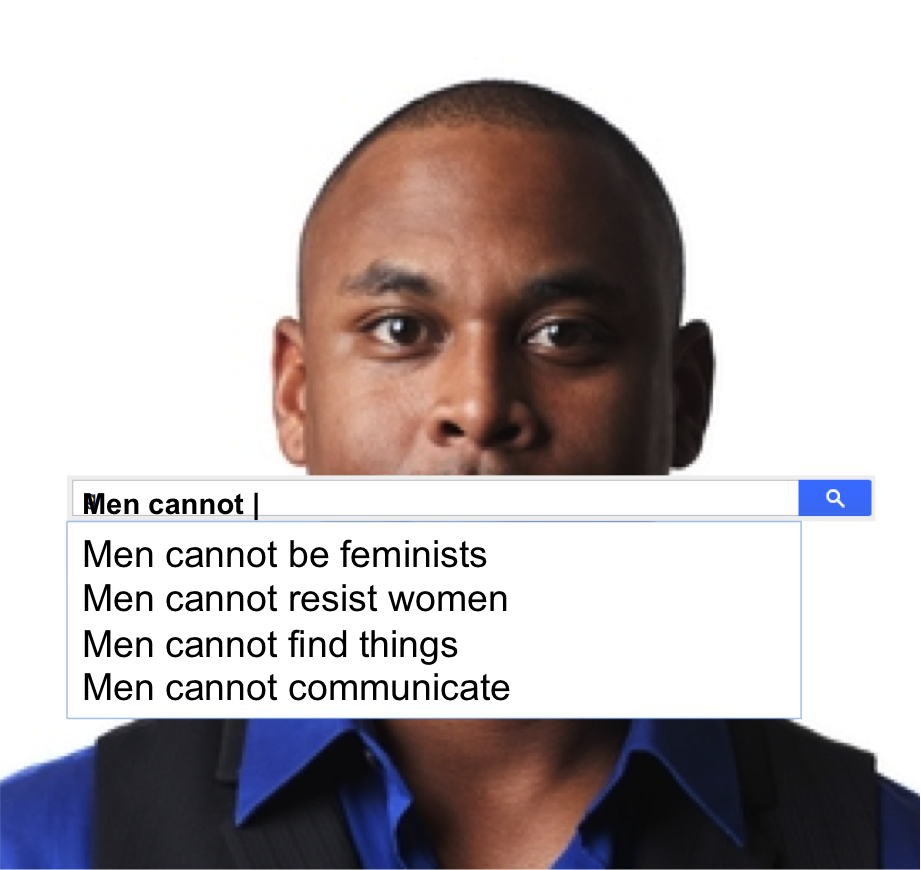
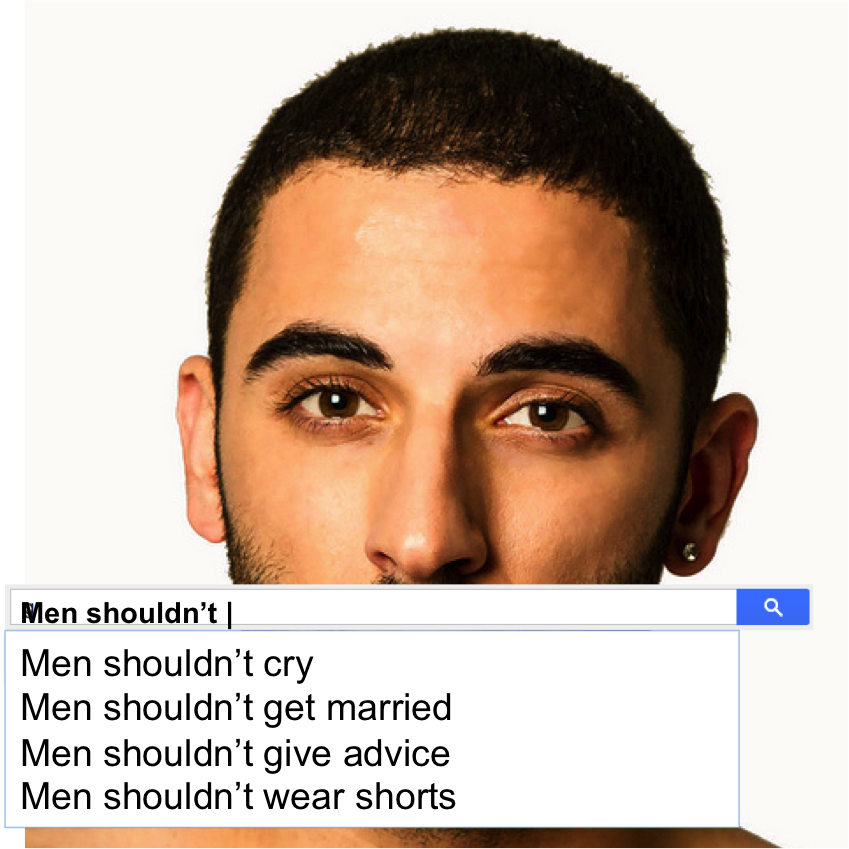


I believe that from all of the information I could have found through the internet, it means something that these photos came to my screen. The fact that I found these tells me that millions of other people have seen them as well. I can’t help but wonder, what would be different about society if these sort of searches were unnecessary? What brought millions of people to search these same things, and what does this mean for the future of the men’s equality movement?
All of these men’s rights issues are only a small fraction of the bigger issues. I think that we, as a society, need to start making these changes. Male or female, female or male, gender should not be a reason or an excuse as to why these problems are still here.
Women's Rights and Feminism
No matter where you are in the world, you have probably heard about women’s rights. You may know little about it, or you may have your own opinion developed on the topic and are ready for discussion. In my opinion, women’s rights are human rights. It seems silly to me that the term ‘women’s rights’ is even something people have to fight for.
“Women’s rights” could be considered as the idea that women are as deserving of their equal human rights as men. Some countries have laws to protect women’s rights, but unfortunately said, many do not. To me, the women’s rights topic should make sure to note that currently, women are not equal to men. For years, women were under the norm and expectations of being a mother, wearing feminine clothing, being a house-wife, and marrying a male at a young age. Women were seen akin to slaves, and although change is happening right now, we need more.

Included in women’s rights are things such as the right to vote, the right to birth control, the right to abortion, the right to equal pay for the same work, and the right to all human rights. (These human rights include the right to be free from rape.) Women total for roughly half of the world’s population. However, the following statistics show that not all women are being granted their rights, and that males and females are not equal.
- ⅔ (66.6%) of the world’s working hours are worked by women, but women only earn 1/10 (10%) of the world’s income.
- Nearly four million females (including girls) are bought and sold across the world every year. This includes prostitution, slavery, and marriage.
- Afghanistan is the most dangerous place in the world for females to live.

In relation to women’s rights, another term is ‘feminism’. Feminism, by my definition as well as the majority of people who also choose to call themselves feminists, is the belief that both male and female genders should be treated equally. I personally think that just because the word is feminism, that does not mean that it is only a female issue. Feminism, according to its definition should mean that everybody interested in gender equality (men and women, males and females) should feel free to identify as a feminist. This is the opportunity where I invite you, male, female, or other, to join the movement for gender equality, and to label yourself as a feminist.
Monday, 18 May 2015
Global Citizenship & Gender Equality
Mission Statement: The purpose of this gender equality blog is to spread my perspective on gender equality to better educate society. I hope that these posts teach you something you didn't know, things you agree with, and most importantly, things you do not agree with. I want to start the conversation in my community to show people that gender equality is something that cannot be achieved without everybody's help. Gender equality is something necessary to the development of the world. Agreeing and disagreeing with my opinions and the opinions I show through my blog will, in my opinion, help this generation and future generations to not stand silent about issues that they care for.
To me, a global citizen is someone who actively supports and works towards a better world. A global citizen is a person whose actions benefit their local, national and global communities, and is aware of their actions and the effects. Also, I believe being a global citizen is necessary and important. If people were not aware of global citizenship, our world would never have the chance to be as globalized and interconnected as it is today.
Global citizens can be activists for many world topics/debates, or just a few. Global citizenship and gender equality go hand in hand. Gender equality is a world-wide issue that exists everywhere, including local, national and global communities. Global citizens can, and are, helping to solve and create awareness for gender equality issues.
Within the past 100 years, the movement for gender equality has grown and evolved. Women and girls were seen as incapable of doing the same things as men. Women were expected to stay at home to do the cooking and cleaning, they were not allowed to vote, and they were not seen as real people. Men and boys were the ones expected to work and provide for their family.

Subscribe to:
Comments (Atom)